
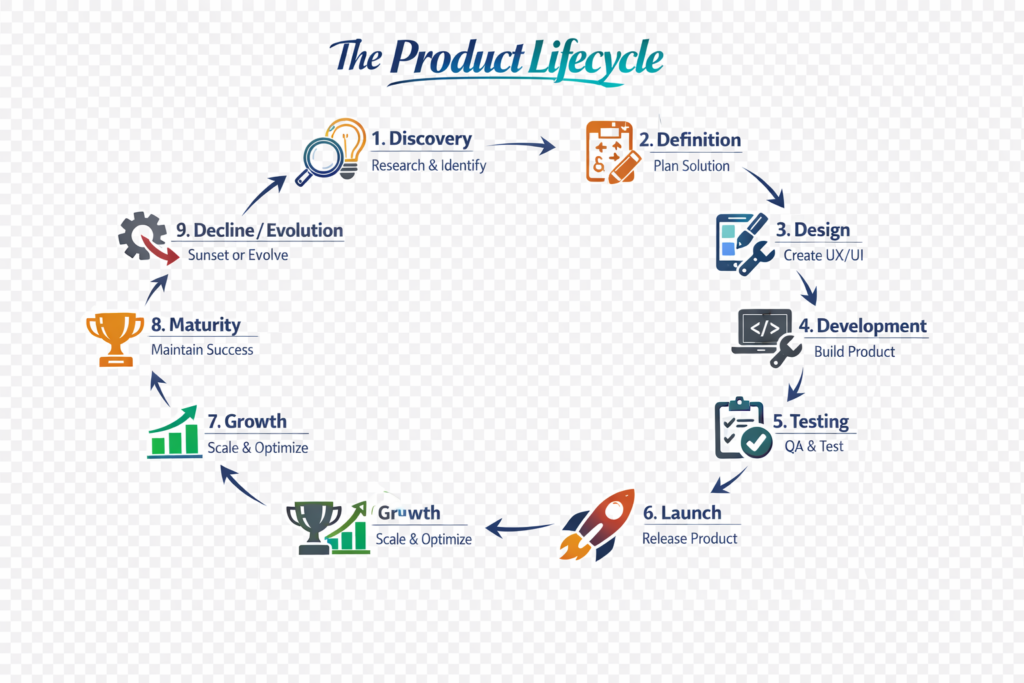
Every successful digital product — whether it’s a website, app, or online service — follows a clear lifecycle. Understanding this process helps businesses reduce risk, build better solutions, and deliver results faster. This guide breaks down the end‑to‑end product lifecycle, starting from problem discovery all the way to launch, growth, and evolution.
1. Discovery Phase — Identifying the Real Problem
The product lifecycle begins with problem discovery. This is where businesses uncover customer pain points, research market gaps, and validate whether the problem is worth solving.
Key activities:
- Customer interviews
- Competitor analysis
- Market research
- Problem validation
2. Definition Phase — Shaping the Right Solution
Once the problem is clear, the next step is defining the solution. This phase sets the foundation for the entire project.
Includes:
- Product vision
- Feature prioritization
- User personas
- Scope definition
3. Design Phase — UX/UI and User Experience
In this stage, ideas turn into visual concepts. The goal is to create a seamless, intuitive experience for users.
Deliverables:
- Wireframes
- User flows
- UI design
- Interactive prototypes
4. Development Phase — Building the Product
This is where the product is built. Developers turn designs into a functional, high‑quality solution.
Tasks include:
- Frontend development
- Backend development
- API integrations
- Database setup
5. Testing Phase — Quality Assurance
Before launch, the product goes through rigorous testing to ensure everything works smoothly.
Testing types:
- Functional testing
- Usability testing
- Bug fixing
- Performance optimization
6. Launch Phase — Delivery and Deployment
The product is deployed and made available to users. This phase includes both technical release and marketing rollout.
Launch activities:
- Deployment
- User onboarding
- Marketing campaigns
- Early feedback collection
7. Growth Phase — Scaling and Improving
After launch, the focus shifts to growth. This is where businesses refine the product based on real user data.
Growth actions:
- Feature updates
- UX improvements
- SEO and marketing
- Customer support
8. Maturity Phase — Stability and Optimization
The product reaches peak performance and a stable user base.
Characteristics:
- Strong market presence
- Incremental improvements
- Competitive differentiation
9. Decline or Evolution — What Comes Next
Eventually, every product faces decline due to market changes or new technology. Businesses must decide whether to sunset, rebuild, or evolve the product.
Options:
- Sunset the product
- Rebuild with new tech
- Pivot to a new version